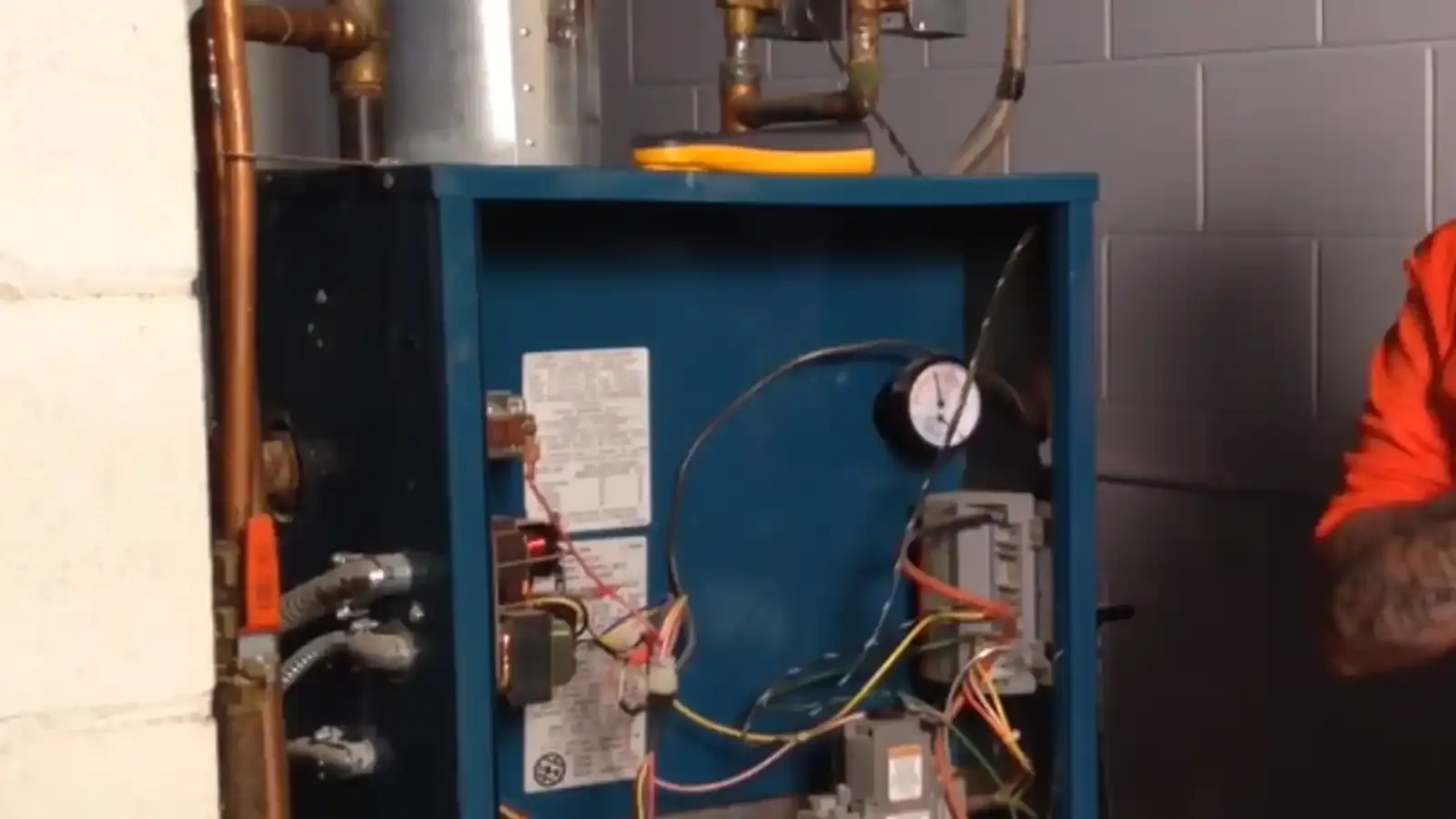
Stop the loss before diagnosing
Turn the boiler off at its switch. Close the water feed valve that fills the system, usually a small valve on a pipe near the boiler. Place a bucket under the drip and take photos. If the leak is heavy, close the main water valve as well. Do not touch electrical components while standing in water.
A boiler is a closed loop, so a leak means pressure will drop and heat will fail. You may notice the pressure gauge falling toward zero and radiators going cold. That is a sign the system needs to be repaired, not just topped up.
Where boiler leaks come from
Pressure relief valve
A valve that opens at high pressure and drips afterward. The cause may be an expansion tank problem, not the valve alone.
Circulator pump flange
Gaskets at the pump flange wear and weep. This is a common, repairable leak.
Pipe joints and fittings
Threaded or soldered joints in the heating loop corrode over time.
Boiler body or heat exchanger
A leak from the casting or the combustion chamber is serious and usually means replacement.
Repair or replace
| Leak location | Typical repair | Replacement likely? |
|---|---|---|
| Relief valve | Replace valve, check expansion tank | Rarely. |
| Pump flange | New gaskets or pump | Rarely. |
| Pipe fitting | Repair or replace section | Only if widespread. |
| Boiler body | Not repairable | Yes. |
What a plumber checks
We confirm system pressure, check the expansion tank, test the relief valve, inspect the circulator and look for corrosion at fittings. If the water is leaking from the boiler casing, we look for signs of long-term seepage such as rust streaks or mineral crust. Those tell us whether the leak is new or has been going on for months.
Boilers can last a long time, but repeated leaks on an old unit add up. We explain the repair cost against the cost of a new boiler and the efficiency you might gain. See our boiler repair page for the full service. If a leak has spread to nearby pipes, leak detection can find hidden moisture.
Safe steps while you wait
These steps limit damage.
- Switch off the boilerUse the emergency switch or the breaker.
- Close the fill valveThis stops fresh water entering a leaking loop.
- Contain the waterUse buckets and towels, and move items off the floor.
- Protect against freezingIn cold weather, keep the house above freezing or drain exposed lines if advised.
Questions to ask about a boiler leak
Ask how old the boiler is and when it was last serviced. Boilers that are properly maintained last for many years, but a leak in the casting often marks the end. Ask what the repair will cost compared with replacement, and what warranty applies to parts and labor.
Ask whether the expansion tank was checked. A waterlogged tank causes pressure spikes that open the relief valve, which then leaks. Replacing the tank is a smaller repair than replacing the valve repeatedly. Ask for the pressure reading before and after the visit.
Ask whether the system can be flushed and treated. Old systems can have sludge that damages the pump and corrodes pipe. A flush with inhibitor extends life. If you plan to replace the boiler soon, ask about sizing so a new unit fits the house, not the old unit.
East Hartford note: fuel, permits and who does what
Boiler replacement usually needs a permit. Ask the East Hartford Department of Inspections and Permits at (860) 291-7340. Gas and oil burner work can need separately licensed trades, so ask who will handle each part of the job. You can verify a license at elicense.ct.gov.
If the leak is wetting a basement floor and your sump or floor drain is also acting up, check whether groundwater is involved. Our sump pump page explains how to tell the difference.
Relief valve discharge and fill-line backflow protection are covered by the International Plumbing Code (IPC), adopted in its 2021 edition by the 2022 Connecticut State Building Code, alongside the boiler manufacturer instructions.
Boiler leaking now?
Shut it off and call. We dispatch around the clock.
Preventing the next leak
Annual service catches worn gaskets, failing valves and low water cutoffs before they leak. Bleed radiators if they trap air, since air in a loop speeds corrosion. Keep an eye on the pressure gauge. A reading that climbs or drops from season to season points to a faulty expansion tank or a slow leak.
Homes near Hartford and West Hartford often have older radiator systems with original piping, and those benefit from yearly checks. If you are not sure when your boiler was last serviced, schedule a visit before winter.
Common questions
A heavy leak or any gas smell is. A small drip can wait for a scheduled visit, but turn the boiler off if water collects.
A leak somewhere in the loop or a failed expansion tank is the usual cause.
Only by following the manufacturer manual. Frequent refilling means there is a leak to find.
Call 911 and your gas utility. Leave the building first.
Yes. We take boiler emergency calls 24/7.