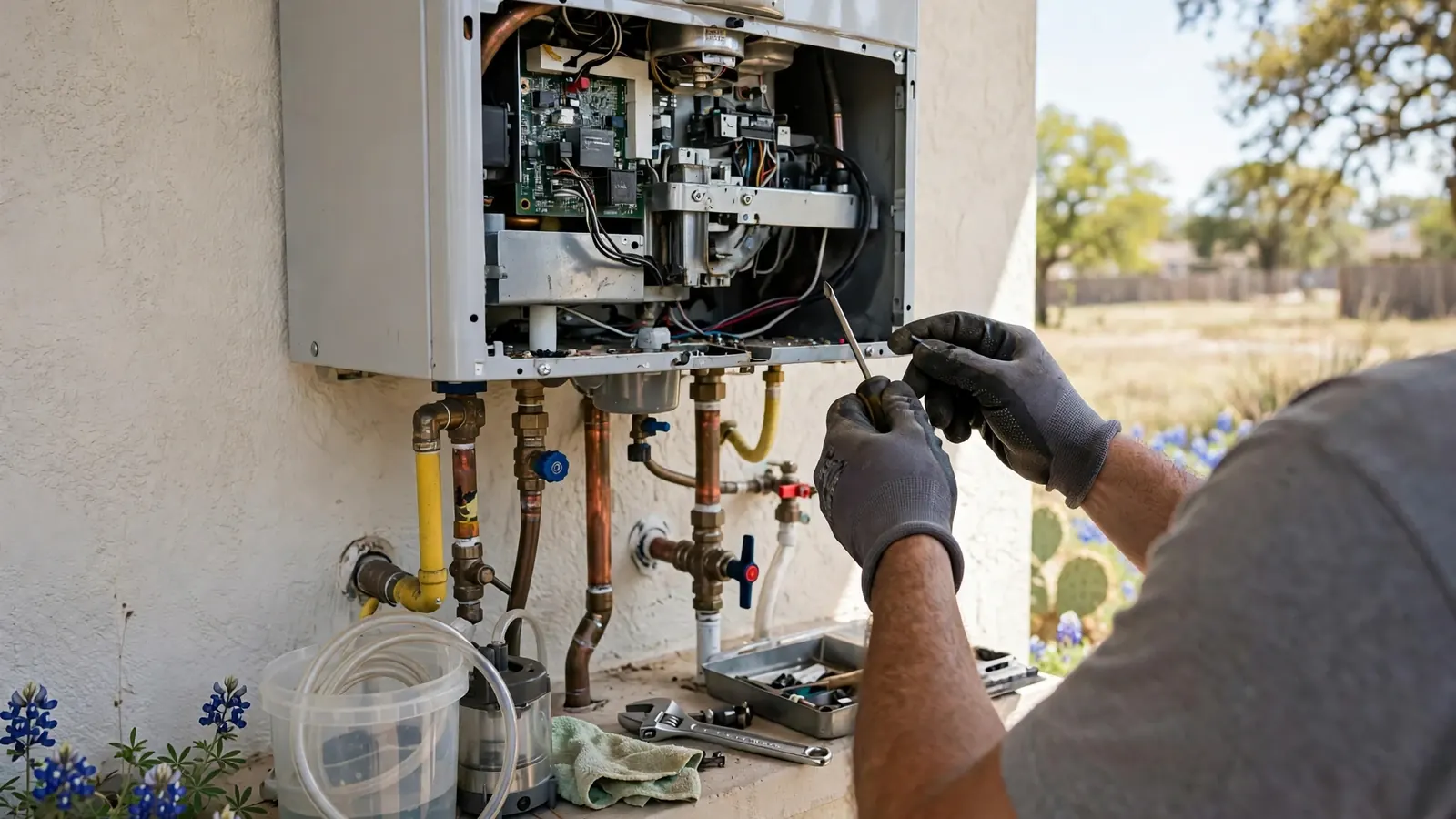
Why tankless needs different service
A tankless heater heats water as it flows, using a burner or elements and a heat exchanger with narrow passages. Those passages scale up faster than the open space inside a tank. That is why tankless units ask for periodic flushing, and why skipping it shows up as lukewarm water, error codes and shutdowns.
Many owners learn this only after a technician tells them the unit is beyond repair. A heater flushed on schedule runs longer and costs less to operate. A heater that was never flushed often needs parts or a replacement. We aim to catch the first group before it becomes the second.
Signs a tankless heater needs attention
These patterns usually point to scale, a sensor or a gas or venting problem.
- Error code on the displayCodes point to ignition, flame, sensor or flow problems. Note the code and the model before you call.
- Water that never gets fully hotThe heat exchanger may be scaled, or the flow rate may be below the minimum the unit needs to fire.
- Temperature swingsFluctuating water often comes from a restricted inlet filter, partially closed valves or a failing flow sensor.
- Noise or a smellKettling sounds indicate scale. A smell of gas means leave the building and call the gas utility.
Flushing and descaling
A flush circulates a mild descaling solution through the heat exchanger using a small pump and two hoses connected to service valves. It runs for a set time, then the system is rinsed and the inlet filter is cleaned. Units without service valves need them installed first, which is a short plumbing job.
How often to flush depends on your water. MDC publishes an annual Water Quality Report and its lab can answer questions at (860) 278-7850, extension 3901. Asking what minerals are in your supply helps set the interval. If your home uses private well water, test it, because mineral content varies much more than on a public system.
Recirculation pumps and wait time
Waiting for hot water at a distant tap is a common complaint.
| Option | What it does | Consideration |
|---|---|---|
| Built-in recirculation | Some tankless models loop water through a return line | Needs a compatible unit and a return path. |
| Under-sink pump | Pushes water to the tap on demand | Adds a small cost and may use the cold line as a return. |
| Dedicated return line | A separate pipe loops water back to the heater | Best performance, more plumbing work. |
Tankless heater throwing an error?
Call with the model number and the code. We tell you whether it is a flush, a part or a bigger problem.
East Hartford note: permits and licensing
Installing a tankless heater changes gas piping and venting, which are regulated plumbing work. East Hartford's Department of Inspections and Permits lists plumbing systems such as water heaters and gas lines among the work that usually needs a permit. Call (860) 291-7340 to confirm for your job.
The Connecticut Department of Consumer Protection licenses plumbing contractors under a P-1 class, which you can verify at elicense.ct.gov before any work. For a conversion from a tank, compare options on our water heater installation page.
Tankless units still need relief protection, correct water connections and approved venting under the International Plumbing Code (IPC) and the manufacturer instructions. Connecticut adopts the 2021 IPC through its 2022 State Building Code.
What affects the cost of tankless service
Service costs depend on the job.
Tankless heaters are often warrantied by the manufacturer, and some warranties require proof of regular flushing. Keep your service records.
Common questions
Yes. We work on most major brands, and callers often reach us after another company said they only replace units.
Many manufacturers suggest at least once a year. Heavier mineral content means more frequent flushes. Ask MDC's laboratory about your water.
Often yes. The right option depends on the model and the pipe layout, and a technician will confirm before quoting.
It points to the system that failed, such as ignition, flame sensing or flow. Share the model and code and a technician can usually narrow the cause by phone.
It suits many homes, but gas line size and venting matter. See water heater replacement if your tank has already failed and you need to compare options.