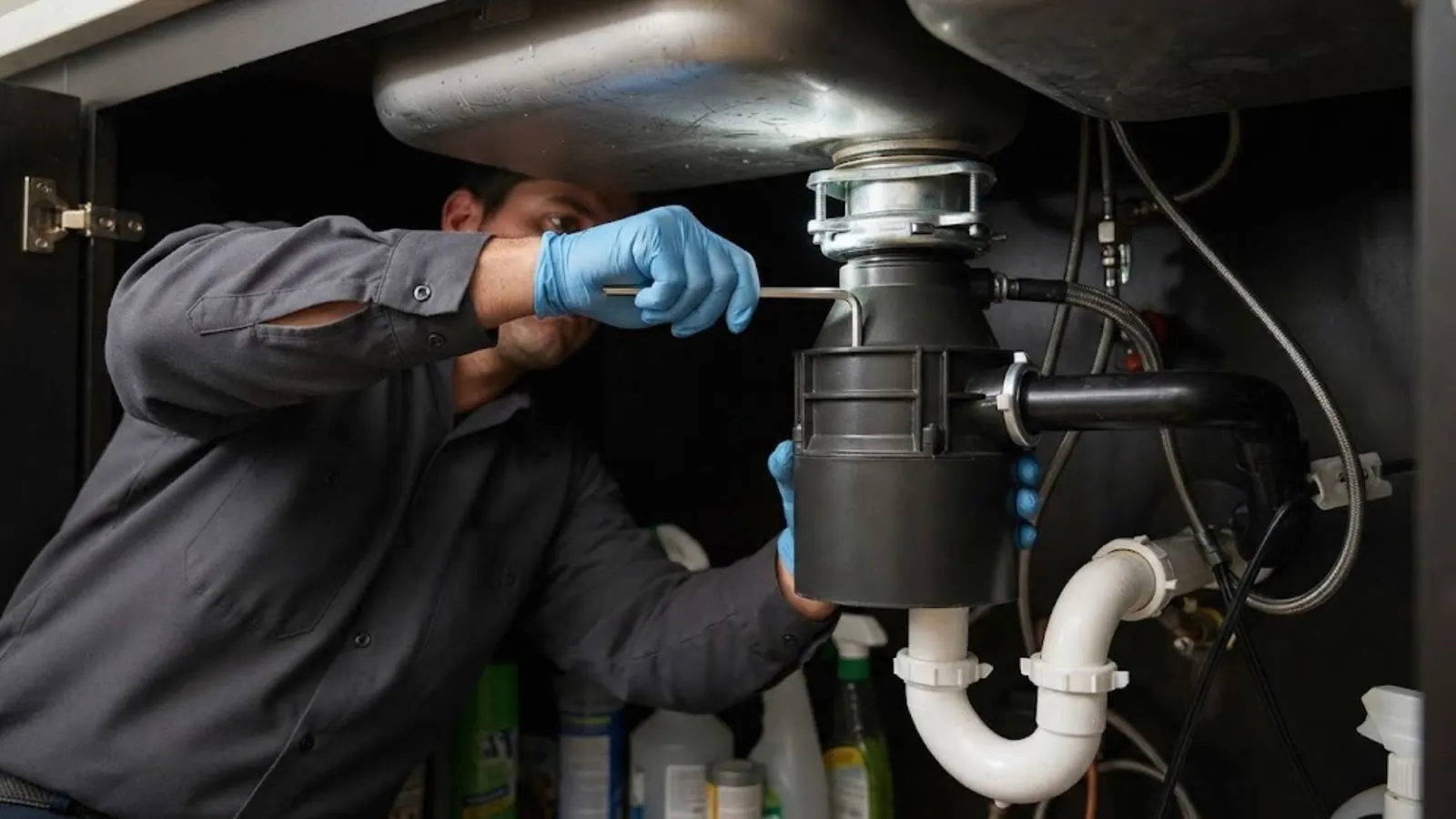
Before you buy anything
Measure the sink cutout, the depth of the cabinet and the location of the drain. Check whether your cabinet has a dishwasher on one side, since the dishwasher drain hose connects to the disposal. Decide between a single and a double bowl, because the drain layout changes.
Choose a disposal sized to your use. A small household can do well with a smaller motor. A busy kitchen benefits from more power. Make sure there is an electrical outlet under the sink, ideally switched on the wall.
The installation sequence
Remove the old sink or disposal
Shut off supplies and power, disconnect the trap and remove the old unit.
Set the sink
Seal and clamp the sink into the countertop cutout.
Install the sink flange
Apply plumber's putty under the flange and secure the disposal mounting assembly.
Hang the disposal
Lift the unit into the mount and lock it. Knock out the dishwasher plug if a dishwasher connects.
Connect the drain and test
Attach the discharge tube to the trap, connect the dishwasher hose, restore power and run water to check for leaks.
Parts checklist
| Part | Purpose | Notes |
|---|---|---|
| Disposal unit | Grinds food waste | Match power to need. |
| Flange and mount kit | Holds unit to sink | Usually included. |
| Discharge tube | Connects to trap | May need cutting. |
| Dishwasher hose and clamp | Drains dishwasher | Needs high loop. |
| Power cord or wiring | Electrical supply | Do not work live. |
Mistakes to avoid
A common error is skipping the dishwasher knockout plug, which leaves the dishwasher unable to drain. Another is over-tightening the mount, which cracks the sink or distorts the seal. A third is forgetting that a disposal needs a trap that slopes away from the wall.
Leaks at the flange are usually from too little putty or uneven tightening. Leaks at the discharge tube come from a worn gasket. If you replace a disposal and the sink still drains slowly, the clog may be in the line beyond the trap. See drain cleaning and garbage disposal repair for help.
Choosing a sink and a disposal that last
Sinks come in stainless steel, composite, fireclay and cast iron. Stainless is light and forgiving, though thin steel can dent and transmit noise. Composite and fireclay resist scratches but can be heavy and need a strong cabinet. Match the sink to the countertop and cabinet, and check the clearance for the faucet holes before you buy.
For disposals, look at motor power, grinding stages and noise insulation. Continuous feed units start with a wall switch and are common. Batch feed units run only when the stopper is in place, which some people prefer for safety. Check the warranty and whether replacement parts are easy to find.
Think about the trap and drain layout. A double bowl with a disposal on one side needs a continuous waste arm to connect the second bowl, and the trap must sit at the right height. A deep sink may need a longer tailpiece. A plumber can sketch the parts before you buy so nothing arrives that does not fit.
Finally, consider noise and use. A disposal does not handle everything, and starchy or fibrous waste is a classic cause of clogs. Run cold water while it works and for a short time afterward so the waste flushes through. Avoid grease, bones and coffee grounds in quantity, and keep fibrous peels out.
Finally, test everything before you close the cabinet. Run hot and cold water, fill the sink and let it drain, run the dishwasher through a short cycle and watch each joint with a dry paper towel held underneath. A slow drip shows up on paper long before it shows up on the cabinet floor, and catching it now saves a swollen base later.
If you rent, ask the landlord before swapping a sink or adding a disposal. Changes to plumbing and wiring in a rental can breach a lease, and the landlord may prefer to use their own plumber.
East Hartford note: permits, electric work and the sewer
A like-for-like swap may not need a permit, but adding a new circuit or moving plumbing might. Ask the East Hartford Department of Inspections and Permits at (860) 291-7340. Connecticut separates electrical and plumbing licenses, so a new outlet may need an electrician. License lookups are at elicense.ct.gov.
Grease sent down a disposal still ends up in the lateral. MDC says the lateral from your house to the main is the homeowner's responsibility. Keep grease out of the sink even if a disposal is installed.
The International Plumbing Code (IPC), adopted in its 2021 edition by the 2022 Connecticut State Building Code, governs the trap, the dishwasher drain connection and the vent for a kitchen sink and disposal.
Want it installed correctly?
Call to schedule. We install sinks, disposals and dishwasher connections.
Nearby towns
We install kitchen plumbing across the area. If you live in Manchester or Glastonbury, mention it when you call. Our faucet and sink repair page covers fixture problems.
Common questions
Many septic systems limit disposal use. Check with your septic contractor before installing one.
You need power under the sink. An electrician should add a circuit if one is missing.
The knockout plug in the disposal inlet may still be in place.
Many homeowners can, but plumbing and wiring mistakes can cause leaks and shocks. A plumber saves time.
Yes. We install and repair them, including emergency calls.