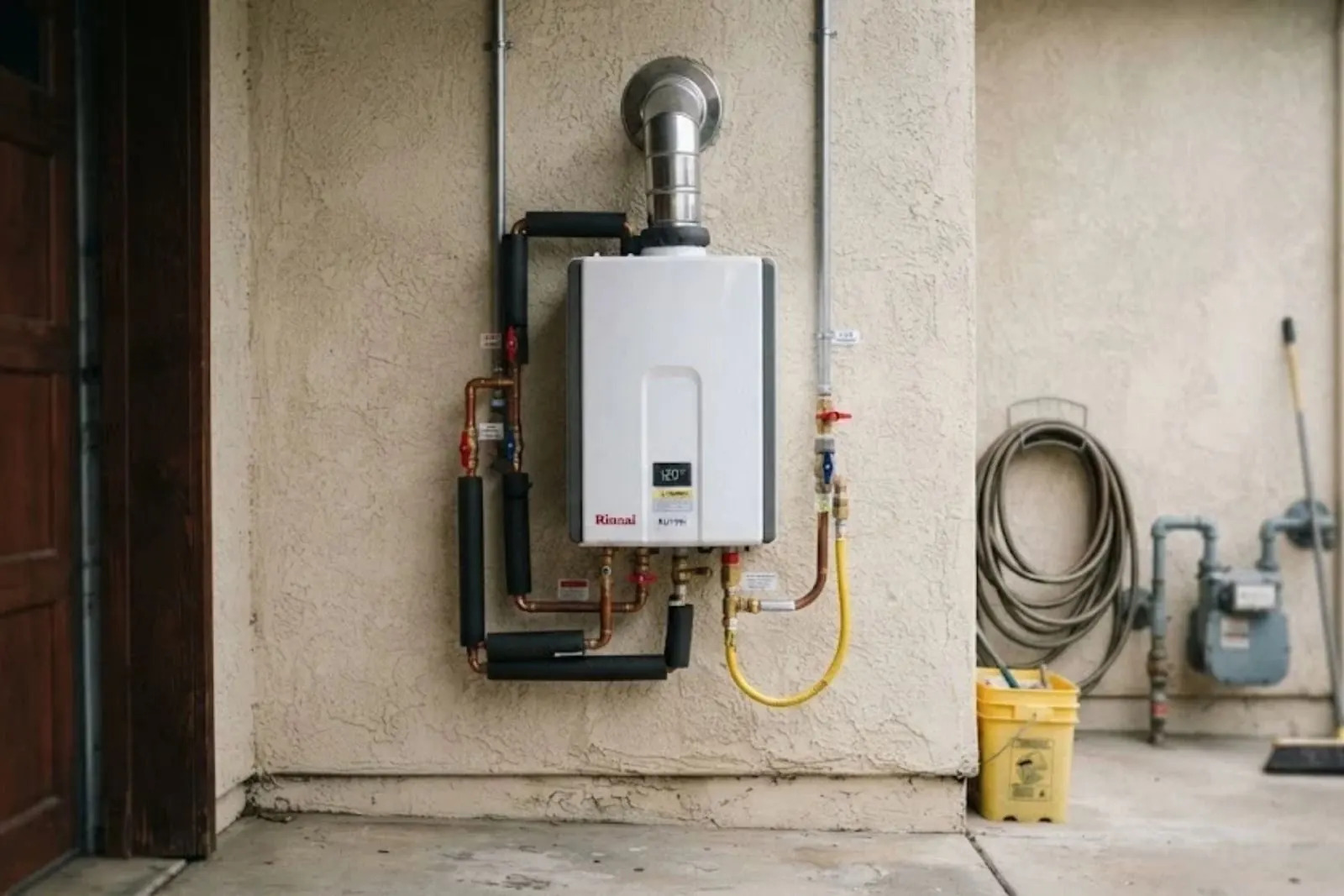
Why tankless waits for hot water
A tankless heater makes hot water only when you open a tap. The heater has to sense flow, fire up and push hot water through the pipe to the fixture. If the fixture is far away, the cooler water already in the pipe comes out first. The longer the pipe, the longer the wait and the more water wasted.
People also notice the cold sandwich, where a brief burst of cold water appears between two hot draws. A pump setup can help with both. See our tankless water heater page for the basics of these units.
Types of recirculation systems
Dedicated return line
A separate pipe returns cooled water to the heater. It works well and is common in new construction.
Crossover valve system
A small valve at the farthest fixture lets the pump use the cold line as a return. It avoids new pipe but warms the cold line slightly.
Built-in pump
Some tankless units include a pump and buffer tank. It can reduce the cold sandwich effect.
Demand activated
A button or sensor starts the pump on request. It saves energy compared with continuous running.
Timer, temperature and demand controls
| Control | How it works | Energy use |
|---|---|---|
| Continuous | Pump always runs | Highest. |
| Timer | Runs at set times of day | Moderate. |
| Temperature sensor | Runs when the line cools | Moderate. |
| Demand button | Runs on request | Lowest. |
Is it worth installing
A pump is most worth it in a house where the master bath is far from the heater, where long waits are common or where you want to cut wasted water. It matters less in a small ranch with the heater close to every fixture. A plumber measures the pipe run and tells you how long the wait really is.
Insulating the hot water pipes is a low-cost step that helps with any system. Continuous pumps lose heat through the pipes, so insulation and a control strategy keep running costs down. Ask for a demand control if your schedule is irregular.
Common problems after a pump is installed
The most common complaint is lukewarm water at the cold tap at the far end of the house when a crossover valve is used. This is expected, because the valve lets warm water bleed into the cold line. Running the cold tap for a few seconds clears it.
Another issue is noise. Pumps hum, and a poorly mounted pump can vibrate through the pipes. A plumber can fit isolating mounts and set the pump on a shelf rather than on a joist. If the noise is a knock or a bang, water hammer may be involved and needs separate attention.
Pumps also fail over time, usually from scale or a worn bearing. A pump with a shutoff valve on each side is easier to replace. Ask for isolation valves at installation, and note the pump model so a replacement can match.
Costs and savings to expect
The cost of a pump system varies by type. A simple crossover kit costs less to buy and install than a new return line. A built-in pump with a small buffer tank comes with the heater. A new return line behind finished walls takes the most labor.
Operating cost depends on the control. A timer set for morning and evening saves energy compared with a pump that runs all day. A demand button costs almost nothing to run. Insulating the hot pipes cuts heat loss and reduces the work the pump must do, so add insulation where it is accessible.
East Hartford note: water, scale and permits
Pumps and tankless heaters are sensitive to mineral scale. MDC publishes an annual Water Quality Report and offers a lab line for questions at (860) 278-7850, extension 3901. Use it to decide whether to add a scale filter or a regular flush.
For permits on plumbing alterations, ask the East Hartford Department of Inspections and Permits at (860) 291-7340. Adding a return line behind finished walls may be work that needs one.
Recirculation lines, check valves and expansion control are part of the International Plumbing Code (IPC), adopted in its 2021 edition by the 2022 Connecticut State Building Code. Follow the heater manufacturer's instructions as well.
Checklist before adding a pump
Ask these questions first.
- Is there a return line?This determines which system fits.
- How far is the farthest fixture?Distance drives the waiting time.
- Is the heater compatible?Check the manufacturer guidance for pump use.
- Which control suits our routine?Pick demand or timer to save energy.
Nearby towns
We install and service these systems across the area. If you live in South Windsor or Glastonbury, the process is the same. When you call, mention the heater model.
Safety steps before you service a pump
Hot water and power both need respect.
- Turn off power to the pumpUse the breaker, not just a switch.
- Close the isolation valvesThen relieve pressure at a tap.
- Let the pipes coolWater in the loop can be hot enough to scald.
- Call a plumber if unsureDo not open gas connections yourself.
Common questions
No. It only moves hot water through the pipes so it arrives sooner.
A pump uses a little electricity and can increase heat loss. A timer or demand control limits it.
Not always. Check the manufacturer guidance and ask a plumber.
Not always. A crossover valve system can use the cold line, though it warms that line slightly.
Yes. Call us with the heater model and layout and we advise on the right system.